
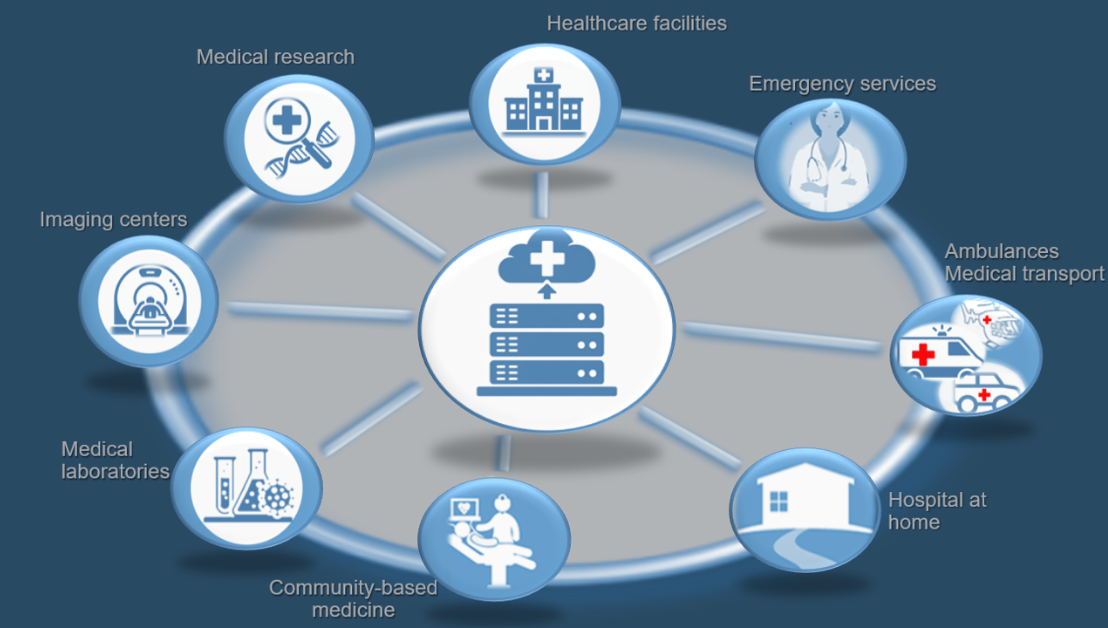
In France, the potential of artificial intelligence in healthcare remains largely underexploited. Not due to a lack of algorithms or skills, but because health data architecture is still too fragmented, heterogeneous, and poorly suited to modern use cases. According to the World Economic Forum, this situation severely limits AI-driven automation and hinders its expected benefits: improved quality of care, diagnostic support, reduced administrative burden for healthcare professionals, and accelerated medical research.
The example of the Dossier Médical Partagé (DMP), launched as early as 2004 but long plagued by high costs and incomplete implementation, illustrates these structural challenges. Despite recent progress, France still lacks a sufficiently coherent, interoperable data foundation designed natively to support reliable, large-scale AI use cases.
Yet digital health data has become both the content and the container of healthcare usage. It now forms the digital walls of hospitals, private clinics, primary care centers, outpatient practices, and even home-based care. It also constitutes the patient’s digital avatar, tracing their care pathway, clinical history, and health determinants. Finally, it is the central tool for healthcare professionals, supporting decision-making, care coordination, and continuity of care.
In this context, transforming health data architecture is not merely a technical undertaking; it is a strategic act of health system governance. Health data carries major scientific and clinical potential. When leveraged through artificial intelligence, it unlocks vast opportunities for research and innovation, as well as new capabilities in diagnosis, treatment, prevention, and cost optimization across the healthcare sector.
If we want to move from experimentation to real transformation, a fundamental question arises: should we prioritize a centralized national health data architecture or a distributed one?
A centralized approach may foster standardization, governance, and certain large-scale research initiatives. Conversely, a distributed architecture may better respect the diversity of healthcare institutions, proximity to the concrete needs of patients and professionals, stakeholder sovereignty, security and performance requirements. But in both cases, no model can succeed without solid foundations.
Whatever the choice, the first and indispensable step remains the same: equipping healthcare organizations and professionals with simple, accessible, and interoperable technological solutions capable of:
- aggregating multimodal primary data (clinical text, imaging, biology, genomics, medical signals, administrative data);
- ensuring strict regulatory compliance (GDPR, French Data Protection Law, Public Health Code, AI Act, Data Act, EHDS, etc.), particularly regarding HDS-certified hosting, traceability, and consent management where required;
- guaranteeing a high level of security, integrity, and confidentiality;
- ensuring data quality and interoperability;
- moving toward greater sovereignty and securing cross-border data flows;
- transforming primary data into usable secondary data to serve research, innovation, public health, and, above all, reliable and high-performance clinical use cases.
Without the ability to structure, secure, and operationalize data upstream, AI will remain a marginal tool. Conversely, by building these foundations as close as possible to healthcare institutions, professionals, and patients, digital health data becomes a true lever for transforming the healthcare system.
Ultimately, AI in healthcare is not primarily about algorithms. It is about data, architecture, and vision. And whoever controls health data architecture effectively drives the transformation of the healthcare system.
These are precisely the issues we will discuss during the second edition of the “Prevention and Longevity” conference, which will take place on February 5th at the Maison de la Chimie. This event will provide an opportunity to debate these structuring choices and to discover concrete, accessible solutions enabling any healthcare institution to build a health data warehouse tailored to its needs, on-premise, with cloud overflow, and integrating next-generation security and interoperability services.
👉 Interested in joining the discussion and moving from convictions to concrete solutions?
Join us to debate the major structuring choices around data and AI in healthcare, meet the stakeholders already transforming the healthcare system, and discover accessible, operational technological innovations for healthcare institutions and professionals.
📅 February 5th – Maison de la Chimie
🔗 Detailed program and registration: https://prevention‑longevite.org

Hicham Temsamani
Hicham Temsamani is a biomedical engineer with extensive international experience in the health sector. After a career at the French National Space Agency (CNES), and then at Panasonic, Cisco, Cardinal Health, AWS and Google Cloud, he founded H.B.T Group France – his strategic consulting firm specialized in digital transformation for healthcare organizations. Passionate about innovation and prevention, he also hosts scientific conferences focused on preventive medicine and longevity.